Showing posts with label This day in family history. Show all posts

Sunday, December 1, 2024

Marriage License Confusion

From a genealogist's point of view, a marriage license is considered an original source. It’s not a copy or secondhand information—it is filled out by the primary participants. Often, the details on the record are considered facts. These documents are incredibly valuable to family historians because they often list the bride and groom's parents, offering a window into one more generation back on both sides of the family tree. Awesome!

On December 1, 1943, my grandparents filled out their marriage license, no doubt a happy day for them! However, there was an unexpected snag for my Grandma Betty. When asked to list her parents on the document, she didn’t write down her biological mother and father. She didn’t even name the relatives who raised her. Instead, she listed her aunt and uncle—the ones who legally adopted her.

Harry and Alma Allen are not Betty's parents. They are her aunt and uncle. 

As a family member who recognized the names on the document (and that they weren't her parents!), I have the advantage of asking difficult questions. I can explore Betty’s complicated relationships and try to understand why she made this choice.

But what if I didn’t have this personal knowledge? What if a non-family genealogist was researching Betty’s family tree? Would they blindly accept the mother and father listed on her marriage license and move on, potentially exploring a completely different lineage?

I’ll admit, I’ve accepted the information on many marriage certificates of my ancestors as fact. I rarely stop to ask, “Were those REALLY their parents?” Most people know the names of their parents, right?

This example gets to the heart of genealogy. Records tell one story, but they don’t always tell the truth—even firsthand, original source records. 

My grandparents' marriage license is a reminder that family trees are complicated and that, at the end of the day, genealogists might never know the real story.


Regardless of the paperwork, my grandma and grandpa got married the next day and were happily married for almost 40 years.


Family member name: Betty Lee Sullivan (Adoptive name: Allen)

Years of life: 1922 - 2007
Places lived: Nebraska, Michigan, New York
Tree branch: Boyle
Relation: My grandma (my mom's mom)

Monday, April 19, 2021

Hastings

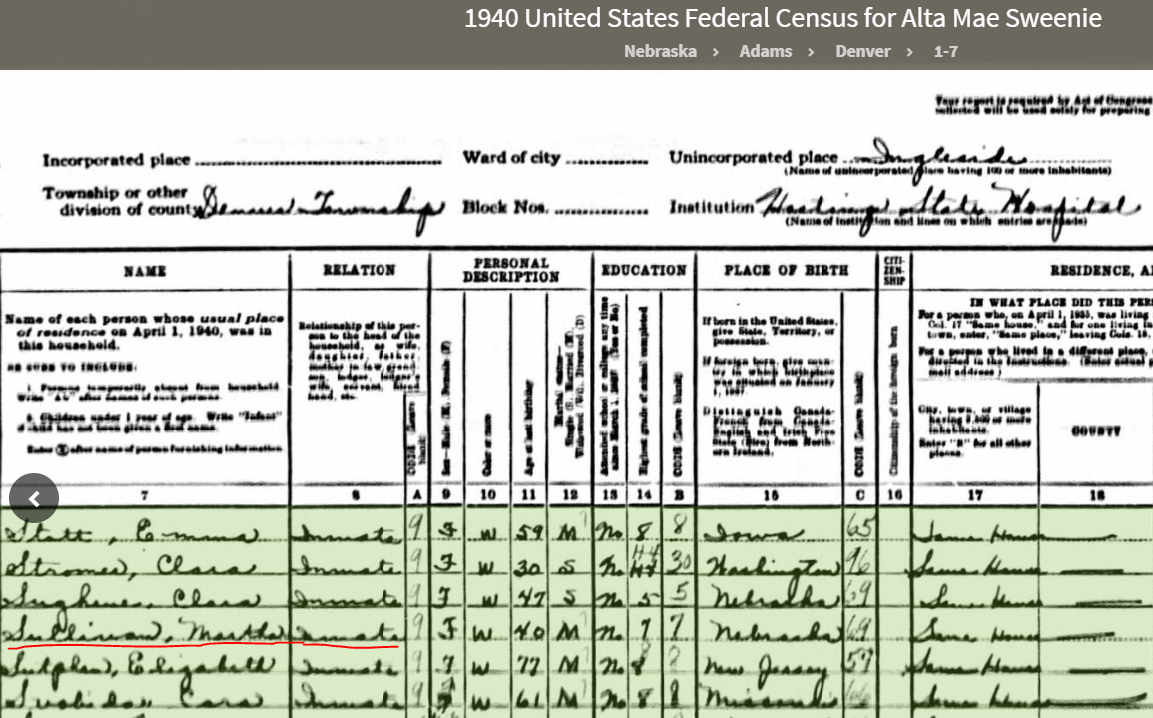
The 1940 federal census in Adams, Nebraska was enumerated 81 years ago this month, April 18, 1940.  It showed where my great-grandmother had been living for about 10 years already.  She was sadly referred to as an "inmate" at a place called Hastings State Hospital.

Family member name: Martha E. Goesch Sullivan
Years of life: 1900-1976
Places lived: Nebraska
Tree branch: Goesch
Relation: My great-grandmother (my mom's mom's mom)


See the red underlined row.  Sullivan, Martha | Inmate


This post is about Hastings.  Hastings was originally built in 1889 to house the "incurably insane," which is so sad if my great-grandmother had that diagnosis.  In an upcoming post we will talk about her and her illness.

Where is Hastings State Hospital?  It's in the middle of the country.  However, this part of Nebraska is only about 45 minutes from where Martha was born and less than two hours from where she was raising her three children in Lincoln.  This is what Hastings looked like. 

My great-grandma lived at this hospital in Nebraska for most of her life.


The patients were trained to care for themselves and their surroundings.  Also, Hastings was designed to be self-sufficient in terms of food.  It had surrounding farms with all kinds of animals and livestock for the patients and staff to eat.

Early attempts to treat the mentally ill began in the 1920s.  But the 1950s saw breakthroughs in treatment with psychiatric drugs and rehabilitation therapies.

Hastings State Hospital was my great-grandmother's home for most of her life.  I can only hope that her life there had bright spots.  Perhaps the inside and gardens were pleasant.  

Had I known this information about my great-grandma, I definitely would have stopped by Hastings on our cross-country drive in 1999 just to see the outside of the buildings.  Hastings is right off of Route 80, which is the route we took at that time.  However, we wouldn't be able to stop by now because after 131 years, Hastings was torn down in 2020.


Sources:
1940 US Federal Census - Adams, Nebraska

Monday, April 5, 2021

Should I stay or should I go?

What happens when farm land is running out in your area and your livelihood is threatened?  How will you support your family?

The town of Roxbury, Massachusetts was founded in 1630.  Just 50 years later, farm land was getting tight.  The town of Roxbury bought land that was 70 miles southwest as an outlet for its "crowded" population and called it New Roxbury, later renamed Woodstock.  Who should populate New Roxbury? The would-be residents voluntarily divided into two groups: the Goers and the Stayers.

Goers
The Goers would move to New Roxbury as soon as arrangements could be made.  They were given the southern half of the town and were promised £100, to be paid by the Stayers over the first few years as funds for the first meeting house and public improvements.  The Goers would divide up the land among themselves.

Stayers
True to their name, the Stayers would stay in Roxbury for a time.  Land lots were assigned to them and set aside in the northern half of New Roxbury from the outset.   The size of their lots were at the rate of ten acres for each shilling contributed toward the £100 promised to the Goers.  

What would you do? Are you a Goer or a Stayer?  

My 8x great-grandfather, Henry Bowen, was a Goer.  

Family member name: Henry Bowen
Years of life: 1633 - 1723
Tree branch: Pearson
Lived in: Wales, UK; Roxbury, MA; Woodstock, CT
Relation: My 8x great-grandfather (my dad's dad's mom's mom's mom's dad's mom's dad's dad's dad)

Grandpa Henry is listed on the town sign in Woodstock, Connecticut as one of the original 13 Goers who settled the town.

The Stayers didn't inhabit their side of town until 15 years later.

Woodstock is a beautiful New England town and sparsely settled today. It indeed gave the Roxbury families room to spread out.  The Goers arrived April 5, 1686 - 335 years ago today.

Sign in Woodstock showing the 13 original Goers.  Henry Bowen is third.

Roxbury Road in the center of town in Woodstock, CT


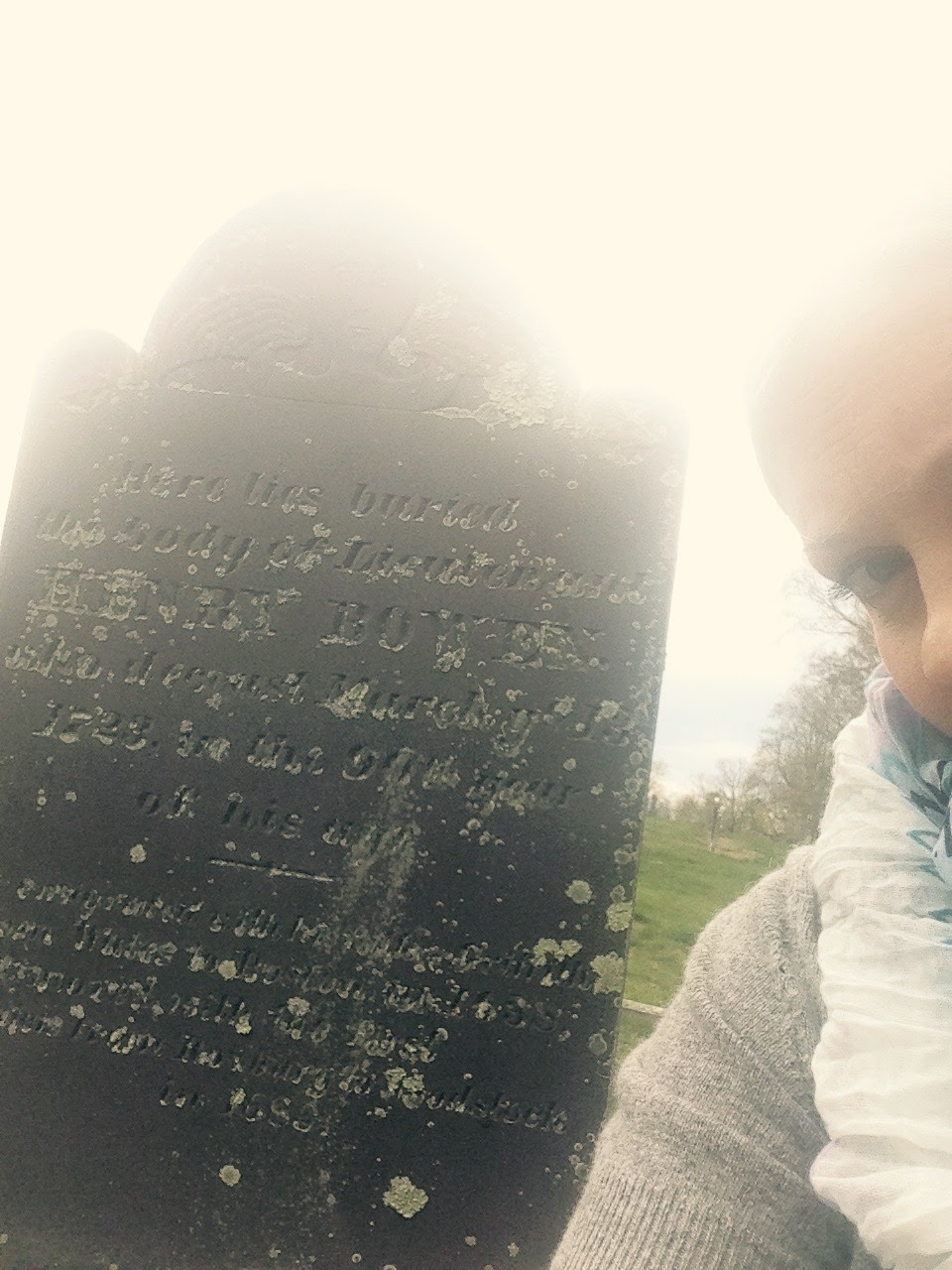
I took a selfie with my 8x great-grandfather's headstone.

PS: During the COVID pandemic, I've definitely been a Stayer.  But outside of those circumstances, I'm an unintentional Goer.

Sources:

Woodstock Historical Society

Dividing the Land: Early American Beginnings of Our Private Property Mosaic, page 62

Woodstock, An Historical Sketch by Clarence Winthrop Bowen, PHD


Sunday, March 14, 2021

"Captured by the Indians"

Living in newly settled territories in the 1600s was not without danger. John Harris and his wife, Amy, were some of the early settlers of North Yarmouth, Maine after moving there from Charlestown, Massachusetts.  That area of Maine, which is just north of Portland, was already known for raids by Native Americans.  John became a victim.  

Family member name: John Harris
Years of life: 1630 - 1695
Tree branch: Pearson
Places lived: Charlestown, MA; North Yarmouth, ME
Relation: My 8x great-grandfather (my dad's dad's mom's dad's mom's dad's dad's dad's dad's dad)

See the highlighted section of the Harris Family portion of the book "Old Times in North Yarmouth, Maine".


Yes, my 8x great-grandfather was captured by Native Americans in 1688 when he was about 58 years old.  At that same occurrence, a prominent citizen named Capt. Walter Gendall was killed.  Grandpa Harris was not the only one captured that day, it seems he was one of many.  

What was it like to be captured?  We don't know what it was like for Grandpa John.  At that time, Native Americans killed the majority of their victims.  Many were held for ransom or sold.  But interestingly, many captives were adopted by the tribe.  Adoption was practiced on a large scale by Native Americans in order to produce peace between the tribe and others. Part of the adoption ceremony stated "you are now one of us" and they were treated as family from then on.  Several firsthand accounts of captured colonists relate that, when given the opportunity to return to their English family, they actually preferred to stay with their new Native American family.

We don't know if Grandpa John was ransomed, let go, escaped or rescued by force.  We don't know how long he was in captivity (days? months?) or how much suffering it involved.  But it is possible that his captivity with the Native Americans in Maine was not torturous, but instead peaceful.

Grandpa Harris passed away seven years later in Rowley, Massachusetts in March, 1695, which is 326 years ago this month.


Sources:
Book "Old Times in North Yarmouth, Maine" by Corliss

Saturday, August 29, 2020

The Poorhouse

One hundred and twenty-eight years ago today, my 3x great-grandmother, Agnes, faced a difficult situation. Let's imagine the circumstances from the point of view of her daughter, Euphemia.  

Agnes lived in Bothwell, Scotland which is west of Edinburgh.


Family member name: Agnes Gilchrist Crosser
Lifetime: 1820-1895
Tree branch: Anderson
Places lived: Scotland
Relation: My 3x great-grandmother (my mom's dad's mom's mom's mom)

My name is Euphemia Anderson and I'm heartbroken.  My mother, Agnes Crosser, just visited our little home to ask us if we could take her in.  Even though we desperately want to help her, there is just no way my husband Robert and I can afford it.

To understand our background, Agnes was a single mom.  Her husband died before I was born and my 38-year-old mom never remarried.  Life was tough for us as she supported us seven children by selling piece work.  My grandparents had passed away, so we were on our own.

Eventually my siblings and I grew up, got married and started our families. Three of us stayed nearby Bothwell, three of my older brothers either died or were out of the picture.  Sadly, my sister Agnes passed away in 1874 when she was just 21 years old.

When my mom was 65 years old in 1885, she was unable to support herself.  That was the first time she came to us for help. By that time we already had five children under the age of 7, with one on the way.  My husband's salary as a miner could barely feed us.   

My sister Ann also tried to help when she could, but having 6 children herself, they also were just surviving. My brother James went to America in 1881 (8 years ago) and has not been in contact.

It is now August 29, 1892, and we have nine children. So since neither of us siblings have the means or the space to take her in, today my mom has to go the Poorhouse.  It's the fourth time since 1885 and it's killing me. 

I don't want my mom to be in the Poorhouse! (Or the Workhouse as the English called it.) The diet and living conditions are very austere (this discourages applications from those who could otherwise rely on family support), so it is definitely a last resort only for those considered destitute. Thankfully they have medical care there.

In 1885, my mom was in the Poorhouse for 11 days, in 1886 for a period of time I can't remember, and in 1890 for 3 days.  Each time, we were able to get her out somehow or she received an allowance from the government.

Fast forward: I'm so happy that my nephew Thomas Porteous is willing to maintain my mom.  He's so sweet to support his grandma.  She was only in the Poorhouse for 12 days this time, and thankfully, it was the last time!

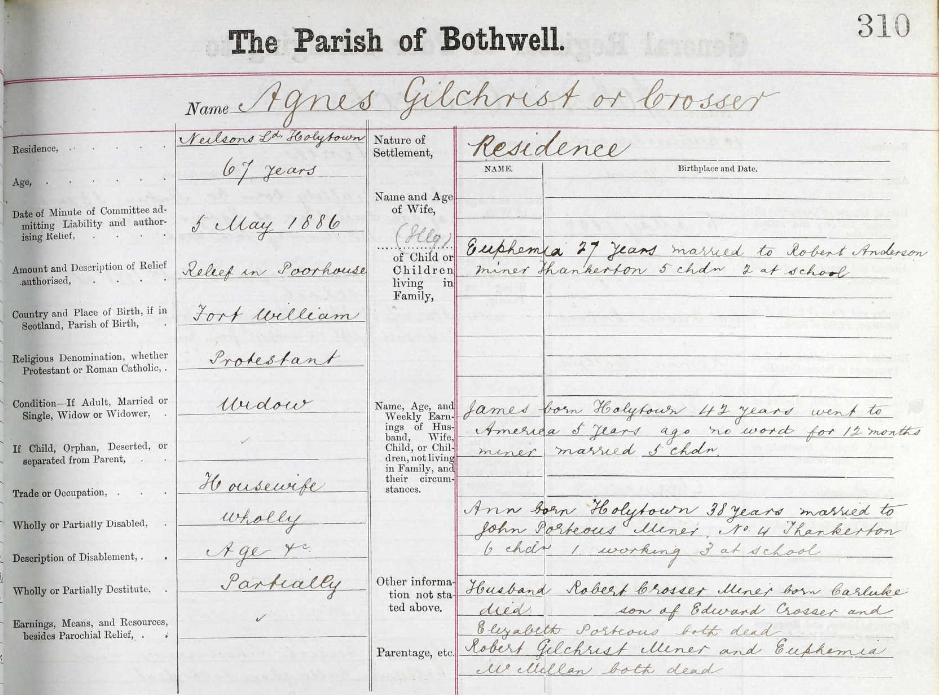
Here is the Poorhouse record for Agnes from Bothwell, Scotland.


Saturday, August 1, 2020

Illegitimate

After researching my five Euphemias from a previous blog post, I decided to try to go further back in the family tree.  But I ran into a brick wall.  Let's go through the facts.

Family member name: Robert Crosser
Lifetime: 1821 - ?
Tree branch: Anderson
Relation: My great-great-great grandfather? (my mom's dad's mom's mom's dad?)

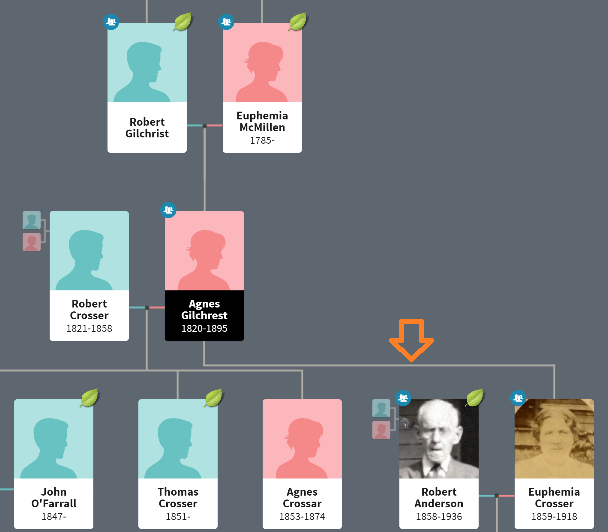
I already knew my great-great-great-grandmother's name was Agnes Gilchrist, (more on her story in an upcoming blog post) so I was researching her husband, Robert Crosser.  Here he is in my family tree.


Here's what we know:
  • Agnes Gilchrist's husband's name was Robert Crosser
  • He was born about 1821 in Carluke, Scotland
  • Agnes' youngest daughter, Euphemia, is my 2x great-grandmother
  • Agnes is a widow on the 1861 census, meaning Robert died before 1861
  • Some believe he died on August 1, 1858, but there is no source material to prove that date  (PS: That is 162 years ago today.)

The Brick Wall: When did Robert really pass away? If he passed away more than 9 months before Euphemia was born in May 1859, that calls into question her ancestry.

With some kind help from two Ancestry.com power-users, I located Euphemia's birth certificate.

Notice that Euphemia is listed as "illegitimate" and no father's name is given.  Also, Euphemia's mother Agnes is shown as a widow.


So now we do not know Euphemia's father's name.  It is lost to time.  (Major brick wall!)

However, years later on Euphemia's marriage certificate, she listed Robert Crosser as her father.  That is confusing.  Maybe her mother told her that Robert was indeed her father.  After all, August 1, 1858 was 9 months and 6 days before her birth, making it technically possible that he was her father.  But again, we're unsure of that date.

Until that date is confirmed, I'll have to consider this birth certificate as fact since Agnes was present and "signed" it with her mark.

So I've updated my family tree with this new information.  Do you notice that the ancestry line for Euphemia only points to Agnes, and not to Robert? Robert Crosser is now only a part of my family tree in that he is my great-great-great grandmother's husband, and not my great-great-great grandfather.


Saturday, July 25, 2020

Three Reasons Family Stories Get Lost

Why is information about our ancestors lost to future generations?  Here's 3 reasons that had an impact on my own family.

Family member name: Nelson F. Smith
Lifetime: 1859-1910
Tree branch: Smith
Relation: My 2x great-grandfather (my dad's mom's dad's dad's)

The lost story
My 2x great-grandfather, Nelson F. Smith grew up in a lighthouse.  Yes! A super cool, famous lighthouse called Chatham Light on Cape Cod.  My family was completely unaware of this until I found it through my family tree research.  But this was relatively recent family history, so how does information like this get lost?  Imagine the stories of storms and rescues and close calls!

Just to be clear, Nelson F. Smith was my grandmother's grandfather.  My grandmother just passed away a few years ago at the age of 98.  She never told us that her family had any connection to Chatham Light, even when we visited Chatham with her.  I don't think she knew.  How could she not have known?  Isn't fun family information passed down to the next generation?

1. Early death
Of course, early death is a major reason why stories don't get passed on to future generations.  Nelson Smith died in Boston at the age of 51 from complications of an infection in his heart.  He died five years before my grandma was born.

So grandma did not receive firsthand information from her grandfather.  However, why didn't her father, Charles Nelson Smith, tell her that HIS own father grew up in a lighthouse?  He may not have known either.  Why not?

2.  Separation
My great-great-grandmother Fannie Naomi was a single mom.  (She is the little girl in the tintype in my last blog post.) She and Nelson divorced at some point, which was very taboo at the time. She moved in with her brother, Francis Gibbs, in Fairhaven, Mass.  So my great-grandfather was not raised by his own father. Uncle Frank was the father figure in his life.  

The marriage of Fannie Naomi Gibbs and Nelson Smith did not get off to the best start.  They were married on Tuesday, March 22, 1887, and 4 months later (yikes! the #1 taboo at the time), little Charles was born on July 25, which is 133 years ago today. 

So, because of the unplanned pregnancy, the rushed wedding and subsequent divorce, Charles may not have had a substantial relationship with his own father, Nelson, and therefore never heard about his childhood in the lighthouse firsthand.

Charles Nelson Smith, my great-grandfather, sporting the world's best bow tie, may not have had a relationship with his father, who grew up in a lighthouse.

3. Hurt feelings
Was there bad blood?  Who divorced who?  Was Charles' father, Nelson, even mentioned at all in conversations?  Did he ever visit him?  Even if Charles knew about his father's childhood in the lighthouse, was there so much hurt that he didn't speak of him to his wife and daughter later in life?  We don't even have a picture of Nelson.

We don't know the circumstances of their relationship, marriage or divorce.  But since such a key piece of information in family history went missing so quickly, it must have been a combination of death, separation and hurt feelings that they just couldn't bear to repeat the stories of the lighthouse.


Wednesday, July 15, 2020

Tintypes

Want to see one of my favorite old family photos?  It's from 1868.  

1868: My great-great grandmother Fannie Naomi Abby Gibbs, about 3 years old and her older brother.

Actually, my family has several pictures dating from the 1860s.  However this one stands out since it includes children.  Who are they?  

Family member name: Fannie Naomi Abby Gibbs
Lifetime: July 15, 1865 (born 155 years ago today) - July 11, 1941
Tree branch: Smith
Relation: My 2x great-grandmother (my dad's mom's dad's mom)

Family member name: Lysander Gibbs
Lifetime: 1856-1923
Tree branch: Smith
Relation: My 3rd great-uncle (my dad's mom's dad's mom's brother)

I love this picture.  It's a tintype.  What is that?


A very underexposed negative image was produced on a thin iron plate. It was blackened by painting, lacquering or enamelling, and coated with a collodion photographic emulsion. The dark background gave the resulting image the appearance of a positive.

Believe it or not, that is the most non-technical definition I could find of a tintype. I really still have no idea what that means, but here's what I learned about tintypes:

  • Tiny, usually 2x3 inches
  • Made of thin iron, not flexible
  • Mounted in paper or cardboard cases
  • Developed in a darkroom in just minutes (a big advancement for the time)
  • Inexpensive
  • In use in the 1860s and 1870s

Notice this tintype has been ever so slightly hand tinted.  Do you notice the kids' pink cheeks? 

And how cute are they?  Isn't it great to see pictures of your grandparents and other ancestors as children? It reminds us that they had lives before we knew them.  Unfortunately, this darling girl's life probably didn't turn out the way she wanted it to.  Stay tuned for an upcoming post...

Sunday, May 10, 2020

Namesakes: My five Euphemias

Euphemia (pronounced you-FEM-ee-ah or oh-FEM-ee-ah) is not a common name these days.  According to the Social Security Administration, its peak popularity as a baby name in the US was between 1903 and 1915.  However, it is more popular in Scotland.

I'm happy to have FIVE Euphemias in my family.

Euphemia #1
Family member name: Euphemia McMillen
Lifetime: 1785 - unknown
Tree branch: Boyle
Relation: My 4x great-grandmother (my mom's dad's mom's mom's mom's mom)

Born in Glasgow, Scotland in 1785.  We don't know much about her except that one of her children was Agnes Gilchrest, who named her own daughter after her mother.  (See Euphemia #2)

Euphemia #2
Family member name: Euphemia Crosser Anderson
Lifetime: 1859 - 1918
Tree branch: Boyle
Relation: My great-great-grandmother (my mom's dad's mom's mom)

Named after her grandmother, she was born in Scotland and married Robert Anderson there. At the age of 35, they moved to the United States and settled in Indiana.  Among their 15 (!) children, they named their 8th Euphemia.

Euphemia #3 - nicknamed Effie
Family member name: Euphemia Anderson Moss
Lifetime: 1887 - 1917
Tree branch: Boyle
Relation: My 2nd great-aunt (my mom's dad's mom's sister)

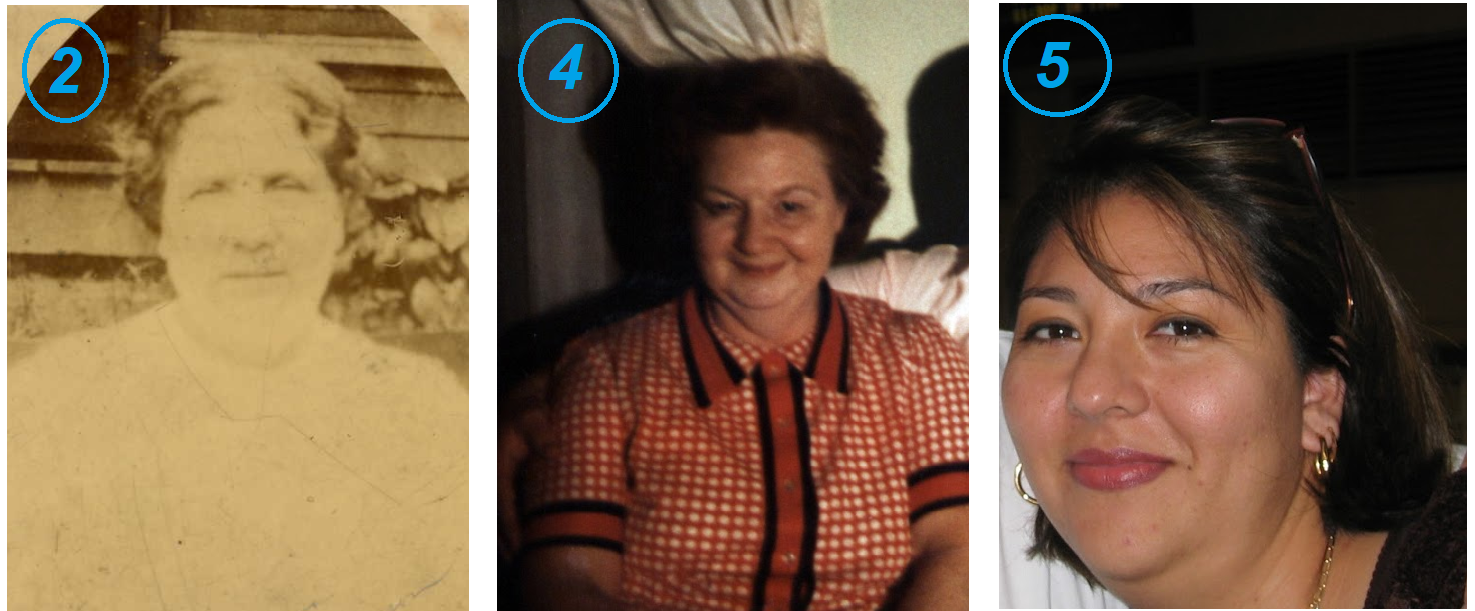
Named after her mother, she was also born in Scotland and was 7 when she came to the US.  She married and had a daughter, named Mildred Euphemia.  Unfortunately, both she and her 6-year old daughter were killed in a tragic car accident on May 10, 1917, which is 103 years ago today.

Euphemia #4 - nicknamed Famie
Family member name: Euphemia Catherine Boyle Koos
Lifetime: 1918 - 1988
Tree branch: Boyle
Relation: My great-aunt (my mom's dad's sister)

Named after her grandmother or aunt who both passed away shortly before her birth. I remember Aunt Famie from our visits to grandma and grandpa's in Michigan.  My mom describes her as "bright and opinionated and suffered no fools." For her husband Vic's work, they moved their young family to Geneva, Switzerland for several years.  


Euphemia #5 - nicknamed Phemie (Phemia in Spanish)
Family member name: Euphemia Melissa Hight Hargreaves
Lifetime: 1975 - 
Tree branch: Hargreaves
Relation: My sister-in-law

A completely British name for my wonderful sister-in-law with Mexican heritage. She was named after her great-grandmother, Eufemia Rosales Osuna from Sinaloa, Mexico.  Fun-loving and smart, she's raising her two lovely daughters in sunny California.

I'm happy to have a picture of 3 out of 5 of my Euphemias.


Sunday, April 19, 2020

The Lexington Alarm

Today is April 19.  245 years ago today the Battle of Concord and Lexington began the American Revolution.  A newspaper article written in 1902 about my family said that one of my ancestors fought in those battles.  Did he?

Family member name: William Morris
Tree branch: Pearson
Lifetime: 1740 - died sometime after 1794
Relation: My 5x great-grandfather (my dad's dad's mom's mom's mom's dad's dad)


See my previous blog post with a full transcription of the article. The article stated,
"Mrs. Titus, too, seems to have come from a family as patriotic as that of her husband, for her paternal grandfather, William Morris, was in the battle of Concord and Lexington and rose in the service until he became a first lieutenant."
Wow! Imagine that, what are the odds?!  Upon reading it, my emotions went from awe to disbelief in about one minute.  (But it was a fun minute!)  I had to investigate this William Morris person.

William Morris was born and lived in Woodstock, Connecticut, not to be confused with Woodstock, New York of music festival fame.  Woodstock is 68 miles from Lexington, Massachusetts.  In April 1775, William could not have fought in the Battle of Concord and Lexington because those battles were fought by Minutemen who lived in those towns and who mustered to Lexington Green in a minute after being awakened by Paul Revere.  Grandpa Morris was simply not there.  The article was incorrect.

However, here is the excerpt from William Morris' military service which may be the cause of the confusion.
"William was clerk of the company which marched from Woodstock in response to the Lexington Alarm."
What is the Lexington Alarm? Once Paul Revere stopped riding, other messengers got on their horses to pick up where he left off.  They rode to other towns to give them the news about Lexington and Concord.  Town militias had already been organized all over New England and the other colonies.  When these volunteer soldiers heard of the fighting, they marched "for the Relief of Boston," including 34-year-old William.  The Lexington Alarm began with Paul Revere's ride and continued with the colonies' response to the beginning of the war.  The Lexington Alarm is not the name of the battle on April 19.  (See timeline on nps.gov)

About 10,000 men marched for days to help defend Boston from the British.  Besides the Rhode Island volunteers, who were somewhat equipped and organized, the rest of the men could hardly be described as "in the military." After reading firsthand accounts of the situation, the camps in the fields and meadows around Boston can only be described as makeshift shelters full of filthy, drunk men. (OK, now you can think about Woodstock the music festival, but with no women or music.)

Since Grandpa Morris only served six days in the Lexington Alarm, they probably marched to Boston, saw they were not needed, then went home to Connecticut. He later served in other regiments.

Here is the link to his page on the Daughters of the American Revolution website: Ancestor #A080956

Researching family history in Woodstock, Connecticut, 2016.


Wednesday, April 17, 2019

A boy named Louis

My Grandma Boyle's paternal grandparents were Eugene C. Sullivan and Louise Auguste Huth.  My research just revealed some facts about Louise's life. 

Family member name: Louise Auguste Huth Sullivan
Tree branch: Sullivan
Lifetime: 1867-1948
Relation: My 2x great grandmother (my mom's mom's dad's mom)


Louise was born in 1867 in Marshall, Michigan, in the palm of the hand near Battle Creek.  Her parents were William Huth and Magdelena (Lena) Dewieghter, both immigrants from Germany.  She was the middle child of five with two older sisters and a younger sister and brother.  Louise only finished the 5th grade.

Just a quick note about how I found this information. I've been searching for years and was frustrated by the brick wall, but finally had a breakthrough!

Louise was mistakenly listed in the census as a boy named Louis.  Maybe the census taker didn't understand her parents' accents or maybe two-year-old Louise had a short haircut and looked like a boy. I don't know, but she was hidden in the census.  But comparing with several other sources, this is definitely her.


Notice the 2-year old male named Louis.  This is my great great grandmother, Louise.

We next find Louise at 17 years old in Nebraska working as a domestic servant.  She married Eugene three years later.  Louise and Eugene had five children in Nebraska, and three lived to adulthood.  However, to date we only know of two of their children, Alfred and Percy.

By the time Louise was 53, her husband passed away and she had moved to Sunnyside, Washington.  She worked as a dressmaker, which she may have learned from her father who was a tailor.  She then moved to Eugene, Oregon in 1924.  She lived there for the rest of her life and passed away in 1948, 13 days after my mom (her great granddaughter) was born.  

Sadly, I can't find any pictures of Louise, yet.  This is all I have.


Friday, April 12, 2019

Third Balloon Company

We don't know much about my mom's grandfather.  It is assumed by all that he was a rat.

Family member name: Alfred Vernon Sullivan
Tree branch: Sullivan
Lifetime: 1897-1960
Relation: My great grandfather (my mom's mom's dad)


He may well have been a real rat.  After all, he gave my great grandmother an STD which ruined her life, then abandoned his three children.

Recently I looked into his military history.  

Alfred enlisted in World War I just six days after the US got involved.  It was April 12, 1917, 102 years ago today.  He served in the 3rd Balloon Company, which was part of the American Expeditionary Forces, the Air Service.  Many men like him from Nebraska, were in balloon companies, since the balloon school was in Omaha.

What was a balloon company?  In 1917, there were no satellites, and planes were in their infancy.  The Allies needed to spy on the Germans.  Enter balloons.  Ninety-three balloon companies were formed during WWI. They were called the "eyes of the army".

Balloon companies were sent behind enemy lines in order to raise a hydrogen balloon (yes, highly explosive) a couple thousand feet in the sky with two men called "observers" with a telescope in the basket.  The balloon was tethered to a winch truck which would move it and haul it back in when done.  The observers would communicate the locations of the enemy troops, not by wireless phone, but with a real phone.  Yes, miles of wires were hung out of the basket to the ground and back to the base! (Can't make this stuff up.) They also made real-time maps.


Alfred was not assigned as an observer, but was a "Chauffer".  Not to be confused with an upscale driver service, a chauffer in a balloon company drove the winch truck, a hydrogen truck or anti-aircraft truck.  Anything that needed driving.  

Since they were behind enemy lines or at the front line, they were sleeping in the open and constantly shot at.  During just one campaign in France which his company was involved in, 21 balloons were shot down.  So he had to dodge fireballs and parachuting observers plummeting from the sky.  Then they had to inflate new balloons on the spot.  A first hand account says, "Personnel weakened by inhaling choride gas, suffering from dysentery... soaking wet from almost continual rain... uniforms crawling with cooties... eating magotty food."

He was in France and Germany for about a year and a half.  One of the towns where they were given leave time was known for its licentiousness, perhaps the place where 20-year old Alfred caught syphilis.

I can't imagine that the guy did not have PTSD.  We don't know if that affected his decisions going forward, or if he just made bad decisions in general.


The Third Balloon Company was assigned to Germany after the Armistice of 11/11/1918 in order to keep peace.

The above facts are not intended to excuse his behavior in any way, however it is always good to understand the bigger picture of someone's life. 

If you're interested in more info about balloon companies, here are some links.

Link to fascinating article in the Omaha World-Herald

Link to North Omaha History - Fort Omaha Balloon School

Link to NY Times article from 1919