Showing posts with label Ancestry Roadtrips. Show all posts

Tuesday, February 4, 2025

1820s Pinterest Goals

When I found out that my ancestor’s home was not only still standing, but welcomed visitors as a bed and breakfast, I was so excited. I HAD to go stay there! 

I really didn't think about what I would learn or how I would feel when I arrived. I just wanted to stand in their shoes for a moment. I never considered that I would learn about my ancestors through how they decorated their home!  Here's the story.

Family member name: Nicholas, Ozni and Hannah Hall
Years of life: 1753-1835
Places lived: Falmouth, Maine
Tree branch: Pearson
Relation: My 5x great-grandfather, his son and daughter-in-law

On February 5, 1823, my 5th great-grandfather Nicholas Hall sold the family home in Falmouth, Maine, to his youngest son, Ozni Hall, for $2,000. How do we know?  That information was included in a document from 1977 regarding the nomination of Hall's Tavern (as it used to be called) into the National Registry of Historical Places.

After the sale, the house was redecorated, as often happens.  Since home décor is usually overseen by the woman of the house, I am attributing the improvements to Hannah Hall, Ozni's wife.  Of course they could have acted as a team, we just can't be sure.

Hannah transformed the house, enlisting a local artist to decorate the walls with stunning stencils. These intricate designs turned a simple home with white walls into a work of art and give us a glimpse of Hannah's personality and creative vision.  

Who was the artist?  This is the subject of much interest to American folk art enthusiasts.  Experts who examined the designs agree that they are in the style of Moses Eaton or his son, Moses Eaton, Jr.  Moses Eaton is now remembered as a renowned artist.  In fact, his stencils and artwork are in museums!  The experts aren't 100% sure, but since Moses was from the local area, it is probable the stencils were done by him.

Bold floral and geographic stencils

These are the original 200-year-old paintings most likely done by Moses Eaton.

So, Hannah turned the house into a masterpiece!

I was fortunate to stay overnight in Hannah’s home in October 2016. Then operating as the Quaker Tavern Bed and Breakfast, the house still carried the warmth and charm that Hannah must have envisioned when she chose the bold pastoral and floral stencil designs. Walking through its rooms, I could picture my ancestors living there, surrounded by the vibrant art that reflected their creativity and love for beauty. Knowing that these walls once held their daily lives was a moving experience for me.


Their beautiful home is a tangible link to my family’s past, a reminder of their hard work, creativity, and vision. Nicholas’s decision to pass the house to Ozni set the stage for Hannah to transform it into something extraordinary—a space that is as much a part of American folk art history as it is my family history. 

This journey reminds me that our ancestors were more than just names on a tree; they were creators, dreamers, and storytellers whose legacy still speaks to us today.


Sources:
* Ancestry.com for the National Register of Historic Places: Inventory--Nomination form
* Proprietor's oral history of Quaker Tavern BnB

Monday, April 5, 2021

Should I stay or should I go?

What happens when farm land is running out in your area and your livelihood is threatened?  How will you support your family?

The town of Roxbury, Massachusetts was founded in 1630.  Just 50 years later, farm land was getting tight.  The town of Roxbury bought land that was 70 miles southwest as an outlet for its "crowded" population and called it New Roxbury, later renamed Woodstock.  Who should populate New Roxbury? The would-be residents voluntarily divided into two groups: the Goers and the Stayers.

Goers
The Goers would move to New Roxbury as soon as arrangements could be made.  They were given the southern half of the town and were promised £100, to be paid by the Stayers over the first few years as funds for the first meeting house and public improvements.  The Goers would divide up the land among themselves.

Stayers
True to their name, the Stayers would stay in Roxbury for a time.  Land lots were assigned to them and set aside in the northern half of New Roxbury from the outset.   The size of their lots were at the rate of ten acres for each shilling contributed toward the £100 promised to the Goers.  

What would you do? Are you a Goer or a Stayer?  

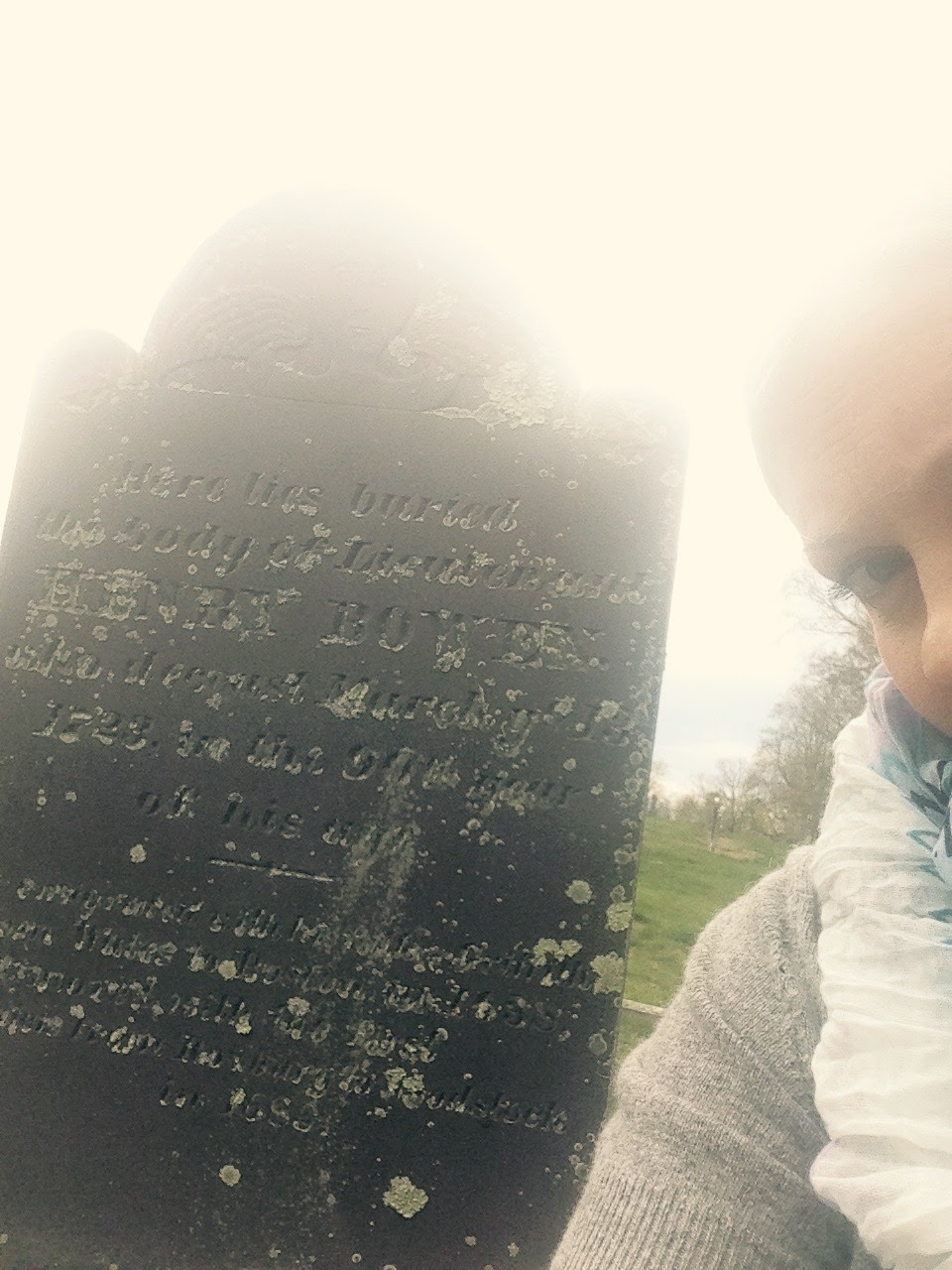
My 8x great-grandfather, Henry Bowen, was a Goer.  

Family member name: Henry Bowen
Years of life: 1633 - 1723
Tree branch: Pearson
Lived in: Wales, UK; Roxbury, MA; Woodstock, CT
Relation: My 8x great-grandfather (my dad's dad's mom's mom's mom's dad's mom's dad's dad's dad)

Grandpa Henry is listed on the town sign in Woodstock, Connecticut as one of the original 13 Goers who settled the town.

The Stayers didn't inhabit their side of town until 15 years later.

Woodstock is a beautiful New England town and sparsely settled today. It indeed gave the Roxbury families room to spread out.  The Goers arrived April 5, 1686 - 335 years ago today.

Sign in Woodstock showing the 13 original Goers.  Henry Bowen is third.

Roxbury Road in the center of town in Woodstock, CT


I took a selfie with my 8x great-grandfather's headstone.

PS: During the COVID pandemic, I've definitely been a Stayer.  But outside of those circumstances, I'm an unintentional Goer.

Sources:

Woodstock Historical Society

Dividing the Land: Early American Beginnings of Our Private Property Mosaic, page 62

Woodstock, An Historical Sketch by Clarence Winthrop Bowen, PHD


Friday, April 2, 2021

Street Signs

Sometimes when a family is well-known in the community and lives there for several generations, a street gets named after them.  Here are some street signs named after my family members that I've come across in my ancestry road trips around New England.

1. Webber Road, Brimfield, Massachusetts

Charles Arnold Webber and family lived on this property in Brimfield for many years in the 1800s.  I'm holding his picture under his street sign and he is my 2x great-grandfather.


2. Morse Street, Putnam, Connecticut

Just over the border of Woodstock, Connecticut is Morse Street.  The Morse family lived in Woodstock since the 1600s. Peter Morse, my 8x great-grandfather, was one of the original settlers of Woodstock.  


3. Peake Brook Road, Woodstock, Connecticut

Sarah Peake is my 7x great-grandmother she was one of the first generation of settlers born in Woodstock whose parents were originally from Roxbury, Massachusetts.  Sarah Peake lived to be 99 years old (1702-1801).  Peake Brook Road was named after their family.


4. Harris Road, Cumberland, Maine

The huge Harris family lived in Cumberland and North Yarmouth, Maine for several generations in the 18th and 19th centuries.  Harris Road is just a couple miles from Turkey Lane and Gray Road, where other Harris family members lived. Amos Harris was my 5x great-grandfather. 


Monday, January 25, 2021

400 years since The Mayflower: The Cooper

What did my 10x great-grandfather do for a living? Where did that profession lead him?

Family member name: John Alden
Tree branch: Smith
Lifetime: 1598 - September 12, 1687
Relation: My 10x great-grandfather (my dad's mom's dad's mom's mom's mom's mom's mom's dad's mom's dad's dad)


John Alden was 21 years old when a group of families approached him to join the crew of the ship that would take them across the ocean.  He met them in Southampton, England. Little did he know they were to be called the Pilgrims, and they were inviting him on a historic journey on the Mayflower that would change his life.  

Why did the Pilgrims want him to come along? He was a cooper.

coop·er
/ˈko͞opər,ˈko͝opər/
noun
  1. a maker or repairer of casks and barrels.

The cooper was a necessary position on any ship. He maintained all barreled supplies and provisions.

* Do you want your food to stay fresh and airtight, and therefore, not die of hunger?
* Do you want your precious beer to stay in the barrel and not leak out?

If the answer is yes, you need a qualified cooper.  They made many different containers from small buckets to large barrels, or casks.  The casks were made of wood planks and metal hoops that bound the planks together.

As a crew member of the Mayflower, and not a Pilgrim, he was expected to return to England when the ship went back in the spring.  However my 10x great-grandfather decided to remain in Plymouth and on April 5, 1621 watched the boat sail away.  He may have made his decision early on, since he was a signer of the Mayflower Compact, which was written when they arrived in November 1620.

The cooper would establish himself as a valuable member of Plymouth Colony. He and his wife Priscilla would have 10 children, of which I am one of tens of thousands of descendants.

Sources:
Wikipedia: John Alden
Colonial Coopers

Visiting the cemetery in Duxbury, MA with my dad.


Wednesday, July 1, 2020

A Business Deal

They were not related, but they're both related to me.  I found their business contract in the Woodstock, Connecticut Town Hall labeled "Morey to Morris".  Let's read it.

Date
February 24, 1775 and in the 15th year of his Majesty's reign

What was Purchased
"A certain tract or parcel of land... by estimation thirty acres be the some more or less with the dwelling house and barn thereon standing and shop adjoining"

Where
"Woodstock in the County of Windham and Colony of Connecticut in New England"

The Seller
Family member name: Ephraim Morey
Lifetime: 1710-1794
Tree branch: Pearson
Relation: My 6x great-grandfather 


The Buyer
Family member name: William Morris
Lifetime: 1740-unknown date of death (after 1790)
Tree branch: Pearson
Relation: My 5x great-grandfather


Price
"The sum of One Hundred Pounds"

I love that my ancestors knew each other!


I scanned this document from a book of land records from the Woodstock Town Hall in 2016.


How I am related to the buyer and seller. You can see that William is from the Morris side and Ephraim is from the Titus side (both from my paternal line).

Here is the book.  There was an index at the front where I saw their names so I didn't have to look through every single page.  But I did end up looking through as many books as possible that day. This picture was taken in the 2 seconds that the lady left the room.  No pictures were allowed, but scanners were allowed. (huh?)


Source:
Woodstock Land Records, Vol 6, 1743-1787

Wednesday, March 4, 2020

400 years since the Mayflower: Captain Shrimp

I'm so disappointed.  

The one thing that I've always known about my heritage is that I'm a descendant of those who came over on the Mayflower, the Pilgrims.  The only ancestor's name I knew for many years was Myles Standish and I was proud of that ancestry.

But I just read up on Grandpa Myles.  Sigh.

Family member name: Myles Standish
Tree branch: Smith
Lifetime: 1584-1656
Relation: My 10x great-grandfather (my dad's mom's dad's mom's mom's mom's mom's mom's dad's mom's dad's dad)


The good news

* Myles Standish was hired by the Pilgrims as a military adviser.  
* Admittedly, he agreed to go on a very dangerous journey across the ocean in 1620, from which many before him had not returned. And he stayed in Plymouth when he had the option to return.
* He did his job.  He protected them in many situations.  For example, he forced them to build a protective wall around the village and organized the men into a militia.
* He was loyal to the Pilgrims.

The bad news

* He was not a Pilgrim, but instead accompanied the Pilgrims.  He did not emigrate to the new world for religious freedom.  It was a job.
* He was very short.  He was called Captain Shrimp.  Yes.
* What a psychopath!  On one mission to defend another small European village called Wessagusset, he brutally killed one of the threatening warriors, and brought the head of another back to Plymouth and displayed it at the fort for months to come.  He did this because that Indian had insulted him beforehand.  These actions had negative consequences on the Colony and the friendly local Indians for years to come.

In summary, Captain Shrimp was a loyal, non-Pilgrim sadist.  But yes, he came over on the Mayflower, and he is my 10x great-grandfather.

Standish is a well-known name in Plymouth County, Massachusetts to this day.  Here are some pictures of when my dad and I visited in 2012.

Standish Monument and my dad.  Duxbury, MA

Plaque for the Myles Standish burying ground.

The gravestone of Myles Standish.  Died 1656, Duxbury, MA.


Friday, May 3, 2019

Shakespeare was a friend of the family. Maybe.

My 12th great grandfather was John Smythe.  I think he must have been friends with William Shakespeare.  :)  Just sayin.

Family member name: John Smythe
Tree branch: Smith
Lifetime: 1580ish - unknown death date
Relation: My 12x great grandfather (my dad's mom's dad's 
dad's dad's dad's dad's dad's dad's dad's dad's dad's dad)

John Smythe lived in Stratford-Upon-Avon in England. He was born around 1580.

You know what that means? Grandpa Smythe lived there during the reign of Queen Elizabeth I. He lived in the same town as William Shakespeare and his wife Anne Hathaway and he lived there at the same time that they lived there.  William was about 20 years older than Grandpa John. 

The population of Stratford-Upon-Avon in 1600 was 2,000.  It was still a small market town where everybody knew everybody.  Even if they weren't close friends, they definitely knew each other.

John's son Ralph was my immigrant ancestor who arrived in Massachusetts in 1630.

PS: All credit for the genealogical findings of the Smith family goes to the helpful genealogist at the Chatham Public Library on Cape Cod.  She sent me a big fat juicy envelope full of photo copies of vital records in the mail.  Amazingly, I received the package only about a week before leaving on our long-awaited vacation to the English countryside.  Before then, I had no idea that I had ancestors who lived in Stratford-Upon-Avon, which was one of our scheduled stops on the trip.

It made me look at the town in a whole new way, through the eyes of my family.  Here we are.

Dru and me in 2017, outside my 12x great grandfather's friends's wife's home.

My 12x great-grandfather's friend's house still stands today in Stratford-Upon-Avon, England.

My 12x great-grandfather's buddy, William Shakespeare.  Photo credit: British Library.


Monday, April 1, 2019

Don't touch the headstone

Yes, I love hunting through cemeteries for my relatives. (Shout out to my husband and mom who come with me and are amazing finders of headstones, which can be needles in haystacks.) Yes, I seek dead people.

This is a quick post with a helpful trick I have found for documenting headstones.

Gravestone rubbings are so 20th century. Some people consider this not only a way of preserving the information on a headstone, but of preserving the art of the actual headstone.  This was ok when every human didn't have a camera in their back pocket  Also, unfortunately, rubbing the stone may cause more deterioration.  Please let it be.

But there are drawbacks when using a camera to document the wording on a headstone.  Moss, weathering and bad lighting are not your friends.  For example, I took this picture of my 8th great grandmother's headstone that has been in Woodstock, CT for over 260 years.


Can read the words? Are you sure??  Argh! After traveling for hours, the last thing you want is for your pictures to be unclear.  So here's my trick.

1. Take the best picture you can.
2. Then take a video of the same headstone and of your voice while reading the words out loud.

Simple but effective. Watch this clip.


Then when I get home and I want to document the dates and wording, I'm not second guessing myself. So, just for the record:

"In memory of Mrs. Hannah Peake, ye wife of Mr. Jonathan Peake, Dec'd October 16, 1756, in ye 90th year of her age."

Family member name: Hannah Leavens Peake
Tree branch: Pearson
Lifetime: 1666-1756
Relation: My 8x great grandmother (my dad's dad's mom's mom's mom's mom's dad's dad's mom's mom)


Thursday, August 23, 2018

Experience Stone's fire

The kitchen is the heart of the home.  As true as that is today, imagine what life was like without our fancy granite-laden, stainless steel clad (not to mention electrified) HGTV kitchens.  

Before the modern stove and indoor plumbing, life revolved around the fire, and homes were built around chimneys and fireplaces.  All cooking was done over the fire.  Taking a bath this week? No fire meant you got a cold bath.  Cold hands and bodies stood by the fire.  Hot coffee was not a push of a button.  Who's gonna wake up early, pump the water then start the fire to get that water boiling?

If the fire went out, your day was ruined.  Families could not leave the fire unattended for very long.

This short post is to imagine my 5x great grandmother, Experience Stone, and all the time she spent at her hearth.

Family member name: Experience Stone (best name ever)
Tree branch: Pearson
Lifetime: 1757-1827
Relation: My 5x great grandmother (my dad's dad's mom's dad's mom's mom's mom)


Not only did she have a husband and 10 children to feed, but they also fed hungry travelers.  Around 1800, they built their new home in Falmouth, Maine and turned it into a tavern.  It was called the Hall Tavern.  Nicholas Hall was her husband.

The Hall Tavern became an Inn.  Over 200 years later it is still an inn, now a historical landmark and called the Quaker Tavern B&B, since the Hall's were Quakers.

Quaker Tavern B&B

It was a gorgeous autumn weekend in 2016 to spend the night at my ancestor's home.  I woke up in their freezing cold bedroom, which is the true Maine experience.  I walked up and down their perfectly creaky stairs. I looked out their original lead-glass windows to see the gorgeous colored leaves, maybe even falling from the same trees.

And I sat at my grandmother's hearth. The fire was out.  But I could see her there, being the best mom and business owner she could be.


Experience Stone's hearth at the Quaker Tavern B&B

Experience Stone's view.


Wednesday, August 1, 2018

Locust Grove

My great great great grandmother was a Morse. Her first cousin was Samuel Morse, the inventor of the telegraph and Morse code (dot dot dash dash). 

Family member name: Samuel Finley Breese Morse
Lifetime: 1791 - 1872
Tree branch: Pearson
Relation: My 1st cousin, 6x removed (meaning = if I was born 6 generations ago we’d be 1st cousins)

I love finding out where my ancestors lived and how they lived. My dad came to visit us one weekend and we drove up to Poughkeepsie, NY to see Samuel Morse’s summer home. 

Just a bit of background... Before Samuel Morse invented the telegraph, he was an artist. Besides a very good start, he was mostly a starving artist (though extremely talented and famous in his own right) and usually could not pay the bills. His wife and children almost never had a home of their own because they couldn’t afford the rent. They lived with different family members and borrowed money often.  


With the riches from the telegraph later on in his life, he bought and extensively renovated a large home north of Manhattan.  The name of the estate is Locust Grove.  It is now a historical landmark and makes for a lovely afternoon tour. Morse was called Finley by his family. The pictures below are of Finley’s first cousin's descendant, my dad.

PS: Locust Grove doesn’t seem to give discounts for family members. ;)


Descendant of Samuel Morse's first cousin.

Outside Locust Grove, Poughkeepsie, NY.  It was pouring.

Locust Grove entry and a carriage similar to what the Morse family would have used.