Monday, January 25, 2021

400 years since The Mayflower: The Cooper

What did my 10x great-grandfather do for a living? Where did that profession lead him?

Family member name: John Alden
Tree branch: Smith
Lifetime: 1598 - September 12, 1687
Relation: My 10x great-grandfather (my dad's mom's dad's mom's mom's mom's mom's mom's dad's mom's dad's dad)


John Alden was 21 years old when a group of families approached him to join the crew of the ship that would take them across the ocean.  He met them in Southampton, England. Little did he know they were to be called the Pilgrims, and they were inviting him on a historic journey on the Mayflower that would change his life.  

Why did the Pilgrims want him to come along? He was a cooper.

coop·er
/ˈko͞opər,ˈko͝opər/
noun
  1. a maker or repairer of casks and barrels.

The cooper was a necessary position on any ship. He maintained all barreled supplies and provisions.

* Do you want your food to stay fresh and airtight, and therefore, not die of hunger?
* Do you want your precious beer to stay in the barrel and not leak out?

If the answer is yes, you need a qualified cooper.  They made many different containers from small buckets to large barrels, or casks.  The casks were made of wood planks and metal hoops that bound the planks together.

As a crew member of the Mayflower, and not a Pilgrim, he was expected to return to England when the ship went back in the spring.  However my 10x great-grandfather decided to remain in Plymouth and on April 5, 1621 watched the boat sail away.  He may have made his decision early on, since he was a signer of the Mayflower Compact, which was written when they arrived in November 1620.

The cooper would establish himself as a valuable member of Plymouth Colony. He and his wife Priscilla would have 10 children, of which I am one of tens of thousands of descendants.

Sources:
Wikipedia: John Alden
Colonial Coopers

Visiting the cemetery in Duxbury, MA with my dad.


Sunday, November 29, 2020

The Tambourer

My 3x great-grandmother, Agnes Gilchrest Crosser, was a tambourer by trade.  What's that?

Family member name: Agnes Gilchrest Crosser
Lifetime: 1820 - 1895
Tree branch: Anderson
Relation: My 3x great-grandmother (My mom's dad's mom's mom's mom)


How do we know she was tambourer?  The 1871 Scotland Census mentions her occupation.  See it highlighted in red.


In French, le tambour means the drum.  It's where we get the word tambourine.  But was my 3x great-grandmother a drummer? No, probably not.  Here is the definition of the word tambour.
aan embroidery frameespecially a set of two interlocking hoops between which cloth is stretched before stitching
bembroidery made on a tambour frame
She most likely was an embroiderer.  Throughout the centuries, when fine clothing with embroidery or beading was made, it was done by hand.  Even though machines have been invented to add beads to fabric, upscale, haute-couture clothing even today is still embroidered by hand.

The tambourer uses a tambour hook tool and fabric stretched tightly across a frame to create beautiful designs.

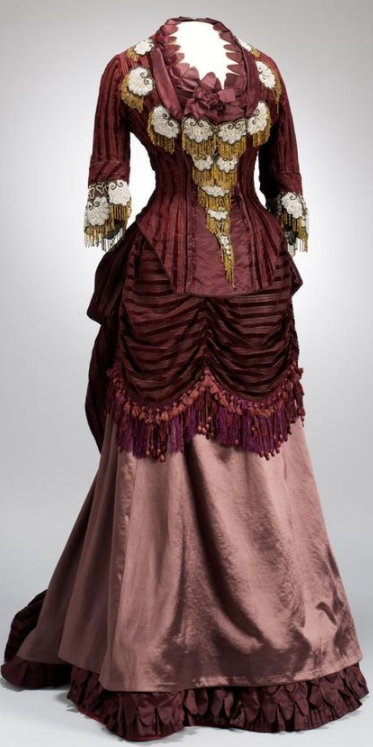
Here is an example of a fancy Victorian dress that was made around the time of this Census.  Perhaps Grandma Agnes was commissioned to add the detailed embroidery to dresses like this.


Sources:
1871 Scotland Census for Bothwell, Holytown

Sunday, November 1, 2020

Warleigh Manor

Do you like British historical TV shows about upstairs/downstairs stories like Downton Abbey?  It turns out my ancestor was part of the "downstairs" staff in a grand English country manor.

Family member name: Charles King
Lifetime: 1775 - 1868
Tree branch: Bromley
Places lived: Near Bath, England
Relation: My 5x great-grandfather (my dad's mom's mom's dad's mom's dad's dad)

An Ancestry.com member kindly posted this scan of some old King family notes.  Notice the area I highlighted in red.  It mentions Charles King, born in 1775, was "for over 50 yrs. valued servant of Skrines, Warleigh M[anor]."


Warleigh Manor is just outside of Bath, England.  It was built in 1815.  If Grandpa Charles was hired as a servant at Warleigh as soon as it was built, he would have been 40 years old at the time.  

I have questions!!!  

What were his duties? Was he the butler? Did he live on the grounds? Or were there servants quarters inside the Manor House? He must have been very "valued" if the family kept him on for 50 years.  He would have been 90 years old when he retired!  Maybe the Skrines thought of him as part of the family, like Carson on Downton Abbey.

Whatever his profession in "service", he did it well.  Congrats Grandpa Charles!

PS: More about Warleigh Manor

* Warleigh is a small parish outside of Bath with a population of 1,759
* The Skrine family bought the land in the 1600s 
* Henry Skrine finished building the current Manor house in 1815 
* It is a lovely early example of a Tudor villa with Victorian additions
* It remained in the Skrine family for seven generation, until the early 1960s
* From the 1960s until the late 1990s it was a reform school for the most emotionally troubled pre-teens in England
* Around 2000, it was sold and underwent a fabulous restoration and now is broken up into luxury "apartments", one that is 4,500 square feet

Links to sources and pictures:


Thursday, October 29, 2020

Descendant of Kings

Yes! I finally found a British King in my family tree!  I am a descendant of Kings!

Family member name: Charles King
Lifetime: 1775 - 1868
Tree branch: Bromley
Places lived: Bath, England
Relation: My 5x great-grandfather (my dad's mom's mom's dad's mom's dad's dad)

Sorry to get your hopes up, but he's not a member of the royal family. heehee. His last name is King.  But, this post is NOT just about a play on words.

Charles was born in Bath, England in 1775 and lived for 93 years, long enough for photography to be invented.  Another descendant of Mr. King generously shared his family photo online for others to see.

This post is simply to say:

* I can't believe that we have a photo of someone born in 1775.  
* And that person is my 5x great-grandfather.  

Here he is!  What do you think?? Is he a sweet grandpa or a curmudgeon?  Please leave a comment below!


Tuesday, October 27, 2020

Signed with a mark

Marriage certificates in Great Britain are great! I love that they include the bride and groom's signatures.  How cool is it to see our ancestor's handwriting?!  However, there is one exception: when they sign with their mark.  What is that?

Let's check out two examples from my family that are 100 years apart.

1871

In 1871, my 2x great-grandfather signed his own name, John Boyle.  But his new bride wrote an X and the clergyman wrote "The mark of Catherine O'Neill".

Family member name: Catherine O'Neill Boyle
Lifetime: 1849 - 1941
Tree branch: Boyle
Places lived: Durham, England; Indianapolis, Indiana
Relation: My 2x great-grandmother (my mom's dad's dad's mom)


1771

In 1771, my 5x great-grandparents, William Fripp and Betty Knight both added their marks with an X.  

Family member name: Betty Knight
Lifetime: 1744 - 1831
Tree branch: Bromley
Places lived: Dorset, England
Relation: My 5x great-grandmother (my dad's mom's mom's mom's dad's dad's mom)


Why?

Why did they sign with a mark?  There are multiple theories.

  • Most likely, the participant could not read or write. Illiteracy was very common prior to 1875 in Great Britain. On the other hand, we can't really assume that those who signed their name were completely literate, as some could write their name, but that's all.
  • They were simply asked to put their mark by the official in charge of the ceremony.  Maybe the official assumed they were illiterate.
  • You never know, they could have been blind!

Saturday, August 29, 2020

The Poorhouse

One hundred and twenty-eight years ago today, my 3x great-grandmother, Agnes, faced a difficult situation. Let's imagine the circumstances from the point of view of her daughter, Euphemia.  

Agnes lived in Bothwell, Scotland which is west of Edinburgh.


Family member name: Agnes Gilchrist Crosser
Lifetime: 1820-1895
Tree branch: Anderson
Places lived: Scotland
Relation: My 3x great-grandmother (my mom's dad's mom's mom's mom)

My name is Euphemia Anderson and I'm heartbroken.  My mother, Agnes Crosser, just visited our little home to ask us if we could take her in.  Even though we desperately want to help her, there is just no way my husband Robert and I can afford it.

To understand our background, Agnes was a single mom.  Her husband died before I was born and my 38-year-old mom never remarried.  Life was tough for us as she supported us seven children by selling piece work.  My grandparents had passed away, so we were on our own.

Eventually my siblings and I grew up, got married and started our families. Three of us stayed nearby Bothwell, three of my older brothers either died or were out of the picture.  Sadly, my sister Agnes passed away in 1874 when she was just 21 years old.

When my mom was 65 years old in 1885, she was unable to support herself.  That was the first time she came to us for help. By that time we already had five children under the age of 7, with one on the way.  My husband's salary as a miner could barely feed us.   

My sister Ann also tried to help when she could, but having 6 children herself, they also were just surviving. My brother James went to America in 1881 (8 years ago) and has not been in contact.

It is now August 29, 1892, and we have nine children. So since neither of us siblings have the means or the space to take her in, today my mom has to go the Poorhouse.  It's the fourth time since 1885 and it's killing me. 

I don't want my mom to be in the Poorhouse! (Or the Workhouse as the English called it.) The diet and living conditions are very austere (this discourages applications from those who could otherwise rely on family support), so it is definitely a last resort only for those considered destitute. Thankfully they have medical care there.

In 1885, my mom was in the Poorhouse for 11 days, in 1886 for a period of time I can't remember, and in 1890 for 3 days.  Each time, we were able to get her out somehow or she received an allowance from the government.

Fast forward: I'm so happy that my nephew Thomas Porteous is willing to maintain my mom.  He's so sweet to support his grandma.  She was only in the Poorhouse for 12 days this time, and thankfully, it was the last time!

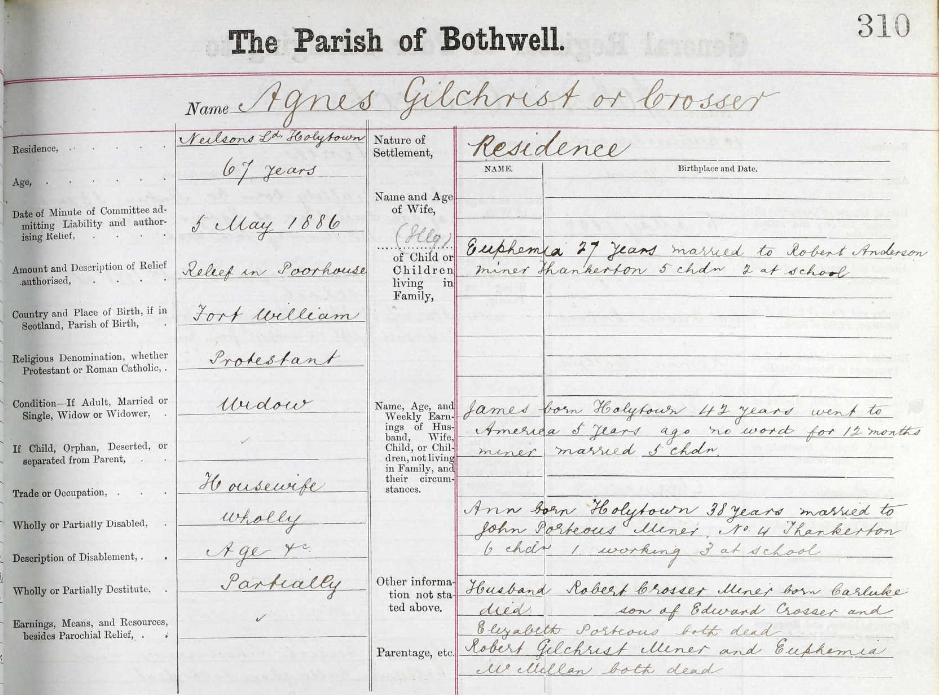
Here is the Poorhouse record for Agnes from Bothwell, Scotland.


Saturday, August 1, 2020

Illegitimate

After researching my five Euphemias from a previous blog post, I decided to try to go further back in the family tree.  But I ran into a brick wall.  Let's go through the facts.

Family member name: Robert Crosser
Lifetime: 1821 - ?
Tree branch: Anderson
Relation: My great-great-great grandfather? (my mom's dad's mom's mom's dad?)

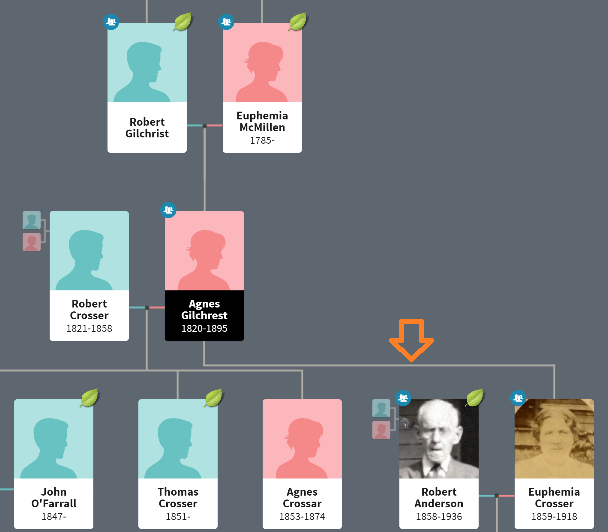
I already knew my great-great-great-grandmother's name was Agnes Gilchrist, (more on her story in an upcoming blog post) so I was researching her husband, Robert Crosser.  Here he is in my family tree.


Here's what we know:
  • Agnes Gilchrist's husband's name was Robert Crosser
  • He was born about 1821 in Carluke, Scotland
  • Agnes' youngest daughter, Euphemia, is my 2x great-grandmother
  • Agnes is a widow on the 1861 census, meaning Robert died before 1861
  • Some believe he died on August 1, 1858, but there is no source material to prove that date  (PS: That is 162 years ago today.)

The Brick Wall: When did Robert really pass away? If he passed away more than 9 months before Euphemia was born in May 1859, that calls into question her ancestry.

With some kind help from two Ancestry.com power-users, I located Euphemia's birth certificate.

Notice that Euphemia is listed as "illegitimate" and no father's name is given.  Also, Euphemia's mother Agnes is shown as a widow.


So now we do not know Euphemia's father's name.  It is lost to time.  (Major brick wall!)

However, years later on Euphemia's marriage certificate, she listed Robert Crosser as her father.  That is confusing.  Maybe her mother told her that Robert was indeed her father.  After all, August 1, 1858 was 9 months and 6 days before her birth, making it technically possible that he was her father.  But again, we're unsure of that date.

Until that date is confirmed, I'll have to consider this birth certificate as fact since Agnes was present and "signed" it with her mark.

So I've updated my family tree with this new information.  Do you notice that the ancestry line for Euphemia only points to Agnes, and not to Robert? Robert Crosser is now only a part of my family tree in that he is my great-great-great grandmother's husband, and not my great-great-great grandfather.