Thursday, October 29, 2020

Descendant of Kings

Yes! I finally found a British King in my family tree!  I am a descendant of Kings!

Family member name: Charles King
Lifetime: 1775 - 1868
Tree branch: Bromley
Places lived: Bath, England
Relation: My 5x great-grandfather (my dad's mom's mom's dad's mom's dad's dad)

Sorry to get your hopes up, but he's not a member of the royal family. heehee. His last name is King.  But, this post is NOT just about a play on words.

Charles was born in Bath, England in 1775 and lived for 93 years, long enough for photography to be invented.  Another descendant of Mr. King generously shared his family photo online for others to see.

This post is simply to say:

* I can't believe that we have a photo of someone born in 1775.  
* And that person is my 5x great-grandfather.  

Here he is!  What do you think?? Is he a sweet grandpa or a curmudgeon?  Please leave a comment below!


Tuesday, October 27, 2020

Signed with a mark

Marriage certificates in Great Britain are great! I love that they include the bride and groom's signatures.  How cool is it to see our ancestor's handwriting?!  However, there is one exception: when they sign with their mark.  What is that?

Let's check out two examples from my family that are 100 years apart.

1871

In 1871, my 2x great-grandfather signed his own name, John Boyle.  But his new bride wrote an X and the clergyman wrote "The mark of Catherine O'Neill".

Family member name: Catherine O'Neill Boyle
Lifetime: 1849 - 1941
Tree branch: Boyle
Places lived: Durham, England; Indianapolis, Indiana
Relation: My 2x great-grandmother (my mom's dad's dad's mom)


1771

In 1771, my 5x great-grandparents, William Fripp and Betty Knight both added their marks with an X.  

Family member name: Betty Knight
Lifetime: 1744 - 1831
Tree branch: Bromley
Places lived: Dorset, England
Relation: My 5x great-grandmother (my dad's mom's mom's mom's dad's dad's mom)


Why?

Why did they sign with a mark?  There are multiple theories.

  • Most likely, the participant could not read or write. Illiteracy was very common prior to 1875 in Great Britain. On the other hand, we can't really assume that those who signed their name were completely literate, as some could write their name, but that's all.
  • They were simply asked to put their mark by the official in charge of the ceremony.  Maybe the official assumed they were illiterate.
  • You never know, they could have been blind!

Saturday, August 29, 2020

The Poorhouse

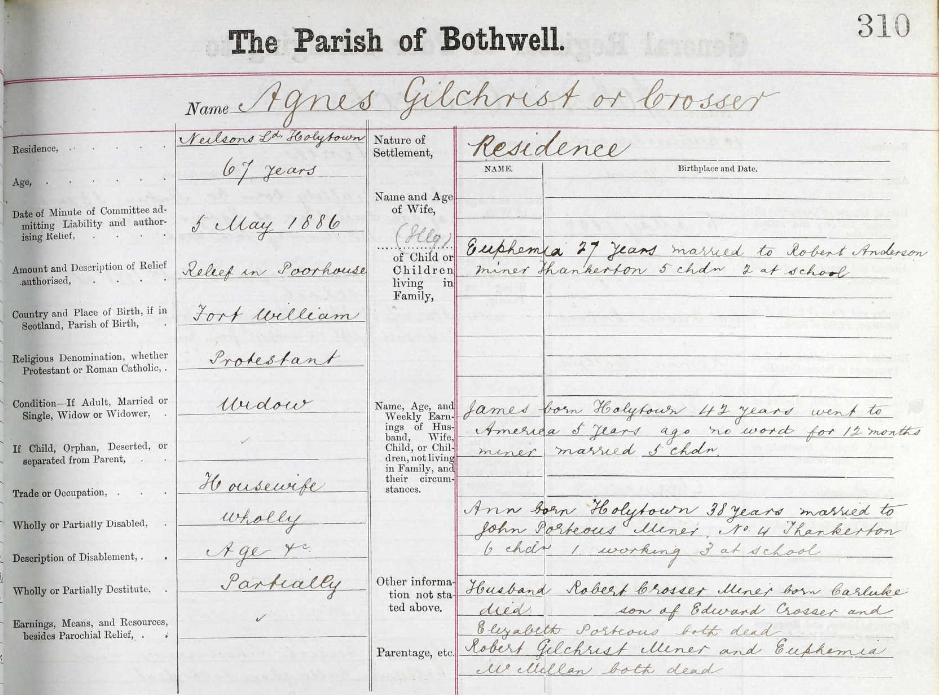
One hundred and twenty-eight years ago today, my 3x great-grandmother, Agnes, faced a difficult situation. Let's imagine the circumstances from the point of view of her daughter, Euphemia.  

Agnes lived in Bothwell, Scotland which is west of Edinburgh.


Family member name: Agnes Gilchrist Crosser
Lifetime: 1820-1895
Tree branch: Anderson
Places lived: Scotland
Relation: My 3x great-grandmother (my mom's dad's mom's mom's mom)

My name is Euphemia Anderson and I'm heartbroken.  My mother, Agnes Crosser, just visited our little home to ask us if we could take her in.  Even though we desperately want to help her, there is just no way my husband Robert and I can afford it.

To understand our background, Agnes was a single mom.  Her husband died before I was born and my 38-year-old mom never remarried.  Life was tough for us as she supported us seven children by selling piece work.  My grandparents had passed away, so we were on our own.

Eventually my siblings and I grew up, got married and started our families. Three of us stayed nearby Bothwell, three of my older brothers either died or were out of the picture.  Sadly, my sister Agnes passed away in 1874 when she was just 21 years old.

When my mom was 65 years old in 1885, she was unable to support herself.  That was the first time she came to us for help. By that time we already had five children under the age of 7, with one on the way.  My husband's salary as a miner could barely feed us.   

My sister Ann also tried to help when she could, but having 6 children herself, they also were just surviving. My brother James went to America in 1881 (8 years ago) and has not been in contact.

It is now August 29, 1892, and we have nine children. So since neither of us siblings have the means or the space to take her in, today my mom has to go the Poorhouse.  It's the fourth time since 1885 and it's killing me. 

I don't want my mom to be in the Poorhouse! (Or the Workhouse as the English called it.) The diet and living conditions are very austere (this discourages applications from those who could otherwise rely on family support), so it is definitely a last resort only for those considered destitute. Thankfully they have medical care there.

In 1885, my mom was in the Poorhouse for 11 days, in 1886 for a period of time I can't remember, and in 1890 for 3 days.  Each time, we were able to get her out somehow or she received an allowance from the government.

Fast forward: I'm so happy that my nephew Thomas Porteous is willing to maintain my mom.  He's so sweet to support his grandma.  She was only in the Poorhouse for 12 days this time, and thankfully, it was the last time!

Here is the Poorhouse record for Agnes from Bothwell, Scotland.


Saturday, August 1, 2020

Illegitimate

After researching my five Euphemias from a previous blog post, I decided to try to go further back in the family tree.  But I ran into a brick wall.  Let's go through the facts.

Family member name: Robert Crosser
Lifetime: 1821 - ?
Tree branch: Anderson
Relation: My great-great-great grandfather? (my mom's dad's mom's mom's dad?)

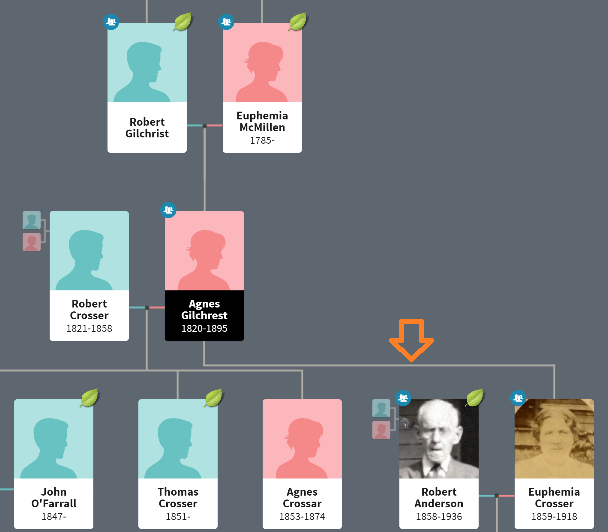
I already knew my great-great-great-grandmother's name was Agnes Gilchrist, (more on her story in an upcoming blog post) so I was researching her husband, Robert Crosser.  Here he is in my family tree.


Here's what we know:
  • Agnes Gilchrist's husband's name was Robert Crosser
  • He was born about 1821 in Carluke, Scotland
  • Agnes' youngest daughter, Euphemia, is my 2x great-grandmother
  • Agnes is a widow on the 1861 census, meaning Robert died before 1861
  • Some believe he died on August 1, 1858, but there is no source material to prove that date  (PS: That is 162 years ago today.)

The Brick Wall: When did Robert really pass away? If he passed away more than 9 months before Euphemia was born in May 1859, that calls into question her ancestry.

With some kind help from two Ancestry.com power-users, I located Euphemia's birth certificate.

Notice that Euphemia is listed as "illegitimate" and no father's name is given.  Also, Euphemia's mother Agnes is shown as a widow.


So now we do not know Euphemia's father's name.  It is lost to time.  (Major brick wall!)

However, years later on Euphemia's marriage certificate, she listed Robert Crosser as her father.  That is confusing.  Maybe her mother told her that Robert was indeed her father.  After all, August 1, 1858 was 9 months and 6 days before her birth, making it technically possible that he was her father.  But again, we're unsure of that date.

Until that date is confirmed, I'll have to consider this birth certificate as fact since Agnes was present and "signed" it with her mark.

So I've updated my family tree with this new information.  Do you notice that the ancestry line for Euphemia only points to Agnes, and not to Robert? Robert Crosser is now only a part of my family tree in that he is my great-great-great grandmother's husband, and not my great-great-great grandfather.


Saturday, July 25, 2020

Three Reasons Family Stories Get Lost

Why is information about our ancestors lost to future generations?  Here's 3 reasons that had an impact on my own family.

Family member name: Nelson F. Smith
Lifetime: 1859-1910
Tree branch: Smith
Relation: My 2x great-grandfather (my dad's mom's dad's dad's)

The lost story
My 2x great-grandfather, Nelson F. Smith grew up in a lighthouse.  Yes! A super cool, famous lighthouse called Chatham Light on Cape Cod.  My family was completely unaware of this until I found it through my family tree research.  But this was relatively recent family history, so how does information like this get lost?  Imagine the stories of storms and rescues and close calls!

Just to be clear, Nelson F. Smith was my grandmother's grandfather.  My grandmother just passed away a few years ago at the age of 98.  She never told us that her family had any connection to Chatham Light, even when we visited Chatham with her.  I don't think she knew.  How could she not have known?  Isn't fun family information passed down to the next generation?

1. Early death
Of course, early death is a major reason why stories don't get passed on to future generations.  Nelson Smith died in Boston at the age of 51 from complications of an infection in his heart.  He died five years before my grandma was born.

So grandma did not receive firsthand information from her grandfather.  However, why didn't her father, Charles Nelson Smith, tell her that HIS own father grew up in a lighthouse?  He may not have known either.  Why not?

2.  Separation
My great-great-grandmother Fannie Naomi was a single mom.  (She is the little girl in the tintype in my last blog post.) She and Nelson divorced at some point, which was very taboo at the time. She moved in with her brother, Francis Gibbs, in Fairhaven, Mass.  So my great-grandfather was not raised by his own father. Uncle Frank was the father figure in his life.  

The marriage of Fannie Naomi Gibbs and Nelson Smith did not get off to the best start.  They were married on Tuesday, March 22, 1887, and 4 months later (yikes! the #1 taboo at the time), little Charles was born on July 25, which is 133 years ago today. 

So, because of the unplanned pregnancy, the rushed wedding and subsequent divorce, Charles may not have had a substantial relationship with his own father, Nelson, and therefore never heard about his childhood in the lighthouse firsthand.

Charles Nelson Smith, my great-grandfather, sporting the world's best bow tie, may not have had a relationship with his father, who grew up in a lighthouse.

3. Hurt feelings
Was there bad blood?  Who divorced who?  Was Charles' father, Nelson, even mentioned at all in conversations?  Did he ever visit him?  Even if Charles knew about his father's childhood in the lighthouse, was there so much hurt that he didn't speak of him to his wife and daughter later in life?  We don't even have a picture of Nelson.

We don't know the circumstances of their relationship, marriage or divorce.  But since such a key piece of information in family history went missing so quickly, it must have been a combination of death, separation and hurt feelings that they just couldn't bear to repeat the stories of the lighthouse.


Wednesday, July 15, 2020

Tintypes

Want to see one of my favorite old family photos?  It's from 1868.  

1868: My great-great grandmother Fannie Naomi Abby Gibbs, about 3 years old and her older brother.

Actually, my family has several pictures dating from the 1860s.  However this one stands out since it includes children.  Who are they?  

Family member name: Fannie Naomi Abby Gibbs
Lifetime: July 15, 1865 (born 155 years ago today) - July 11, 1941
Tree branch: Smith
Relation: My 2x great-grandmother (my dad's mom's dad's mom)

Family member name: Lysander Gibbs
Lifetime: 1856-1923
Tree branch: Smith
Relation: My 3rd great-uncle (my dad's mom's dad's mom's brother)

I love this picture.  It's a tintype.  What is that?


A very underexposed negative image was produced on a thin iron plate. It was blackened by painting, lacquering or enamelling, and coated with a collodion photographic emulsion. The dark background gave the resulting image the appearance of a positive.

Believe it or not, that is the most non-technical definition I could find of a tintype. I really still have no idea what that means, but here's what I learned about tintypes:

  • Tiny, usually 2x3 inches
  • Made of thin iron, not flexible
  • Mounted in paper or cardboard cases
  • Developed in a darkroom in just minutes (a big advancement for the time)
  • Inexpensive
  • In use in the 1860s and 1870s

Notice this tintype has been ever so slightly hand tinted.  Do you notice the kids' pink cheeks? 

And how cute are they?  Isn't it great to see pictures of your grandparents and other ancestors as children? It reminds us that they had lives before we knew them.  Unfortunately, this darling girl's life probably didn't turn out the way she wanted it to.  Stay tuned for an upcoming post...

Wednesday, July 1, 2020

A Business Deal

They were not related, but they're both related to me.  I found their business contract in the Woodstock, Connecticut Town Hall labeled "Morey to Morris".  Let's read it.

Date
February 24, 1775 and in the 15th year of his Majesty's reign

What was Purchased
"A certain tract or parcel of land... by estimation thirty acres be the some more or less with the dwelling house and barn thereon standing and shop adjoining"

Where
"Woodstock in the County of Windham and Colony of Connecticut in New England"

The Seller
Family member name: Ephraim Morey
Lifetime: 1710-1794
Tree branch: Pearson
Relation: My 6x great-grandfather 


The Buyer
Family member name: William Morris
Lifetime: 1740-unknown date of death (after 1790)
Tree branch: Pearson
Relation: My 5x great-grandfather


Price
"The sum of One Hundred Pounds"

I love that my ancestors knew each other!


I scanned this document from a book of land records from the Woodstock Town Hall in 2016.


How I am related to the buyer and seller. You can see that William is from the Morris side and Ephraim is from the Titus side (both from my paternal line).

Here is the book.  There was an index at the front where I saw their names so I didn't have to look through every single page.  But I did end up looking through as many books as possible that day. This picture was taken in the 2 seconds that the lady left the room.  No pictures were allowed, but scanners were allowed. (huh?)


Source:
Woodstock Land Records, Vol 6, 1743-1787